
The Lancet profiles EECC Global co-founder Tim Baker
Following the EECC in Tanzania programme receiving the inaugural Lancet–Elsevier Foundation Evidence to Impact Award, The Lancet has published a profile of EECC Global co-founder Dr Tim Baker, highlighting the global burden of critical illness, the development of Essential Emergency and Critical Care (EECC), and the movement to improve care for critically ill patients worldwide.
In the profile, Tim explains why acute care should be recognised as a global health priority.
"Global health has traditionally focused on health promotion and preventing disease. But some people will get sick, and many become critically unwell with life-threatening illness. Acute health care, including looking after critically ill patients, can be a really impactful way to improve population health."

The article traces Tim's journey from working as a volunteer doctor in rural Tanzania to leading research and implementation focused on improving care for critically ill patients. It explores the findings of the African Critical Illness Outcomes Study (ACIOS), which found that one in eight hospital inpatients is critically ill, yet fewer than half receive the essential care they need.
As Tim explains:
"Often, when people think of critical illness, they assume these patients are in ICUs... But ACIOS found that one in eight inpatients are critically ill... They're scattered through the hospital. They're not on ICUs. They're on the paediatric ward. They're on the maternal ward. They're on the surgical ward. They're all over the place."
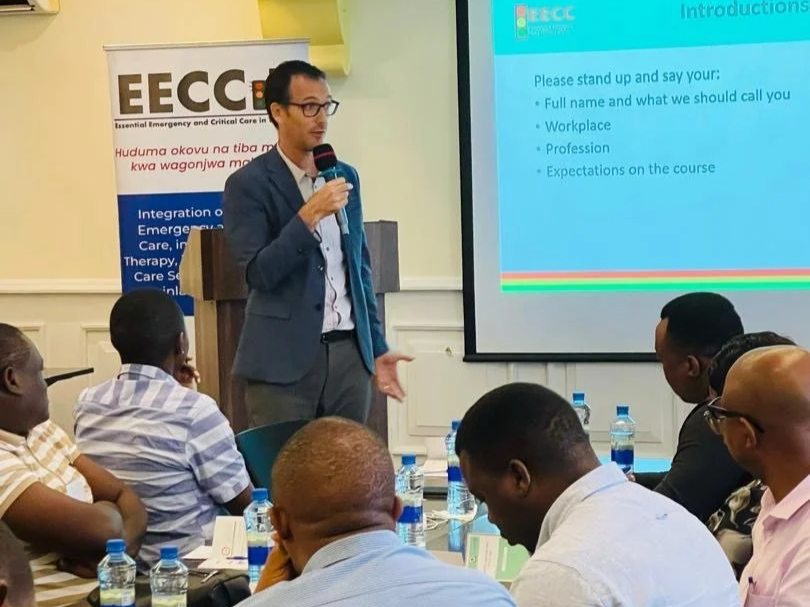
Tim participating in a co-creation workshop as part of the EECC in Tanzania program.
The profile also describes the development of Essential Emergency and Critical Care (EECC), a low-cost systems approach designed to ensure every critically ill patient receives the basic life-saving care they need.
"Critical illness is a massive and neglected problem, and we've developed a solution that is cost-effective and feasible for all hospitals in the world."
Looking ahead, Tim emphasises that generating evidence is only part of the challenge. The next step is ensuring that governments, health systems and healthcare professionals can successfully implement EECC at scale.
"We need governments, global organisations, funders, specialist societies, individual doctors and nurses to realise the importance of this and start doing it."
The profile concludes by looking ahead to the continued expansion of EECC through the growing global network of researchers, clinicians and policymakers working to improve care for critically ill patients.
Read Tim's profile in The Lancet