
EECC Approaches Continue to Spread Around the World
Essential Emergency and Critical Care (EECC) is designed to improve the care of critically ill patients using simple, evidence-based interventions that can be delivered in any hospital.
One of those approaches – Vital Signs Directed Therapy (VSDT) – continues to gain momentum internationally.
A new implementation project led by Stanford University, in partnership with ReSurge International, will introduce VSDT in the burns unit at Kiruddu National Referral Hospital in Uganda. The 18-month programme aims to improve the recognition and treatment of deteriorating patients by linking abnormal vital signs to immediate clinical actions.
The project addresses an important challenge faced by many hospitals in low-resource settings. At Kiruddu Hospital, limited specialist staff and postoperative monitoring can delay recognition of life-threatening complications. By training bedside providers to recognise physiological danger signs and respond immediately, the project aims to improve perioperative care for some of Uganda's most vulnerable patients.
The initiative combines a needs assessment with virtual and face-to-face training led by Stanford anaesthesia trainees and fellows.
As Dr Tiffany Kung, the project's co-principal investigator, explains:
"We are teaching local bedside providers to understand why it is important to monitor vital signs and exactly how to actively respond to and treat clinical abnormalities, moving them beyond passive observation."
Developed through EECC research, VSDT provides clear clinical actions linked to abnormal vital signs, helping healthcare workers recognise critical illness early and deliver timely treatment. It has already been implemented in multiple countries and has been shown to improve the delivery of essential care for critically ill patients.
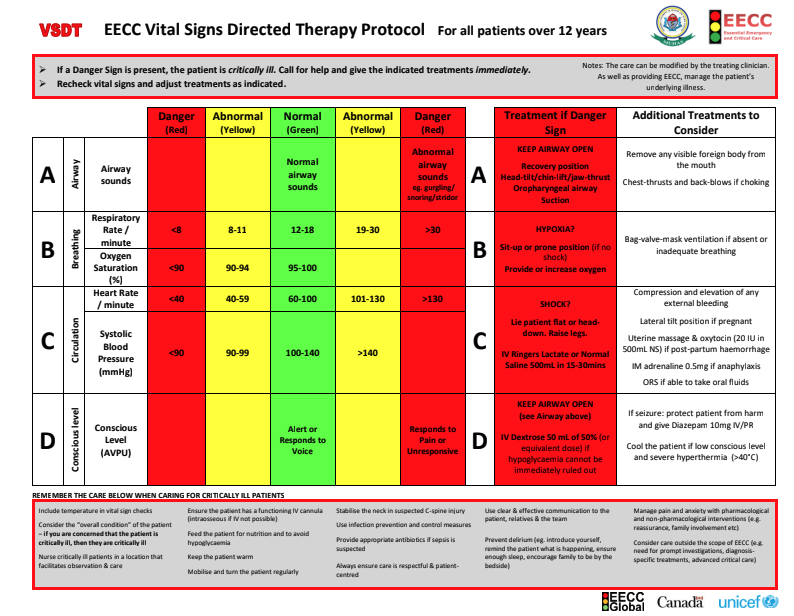
VSDT Protocol for adults
It is encouraging to see organisations around the world adapting and applying EECC approaches to meet local needs. As countries continue strengthening emergency, critical and operative care, the growing use of tools such as VSDT demonstrates how practical, evidence-based interventions can spread well beyond the programmes in which they were first developed.