
After a 31% Reduction in Hospital Deaths, What Comes Next?
When a health intervention demonstrates impact, the next challenge is often bigger than the first: how do you move from success in selected locations to sustainable change across an entire health system?
That is the question now facing Essential Emergency and Critical Care (EECC) in Tanzania.
Over the past two years, the Government of Tanzania, in collaboration with partners, has implemented EECC across health facilities in five regions of mainland Tanzania and Zanzibar. The programme focused on strengthening the basic lifesaving care provided to critically ill patients through training, leadership development, practical clinical tools, improved resource readiness, and continuous monitoring.
The results have been remarkable.
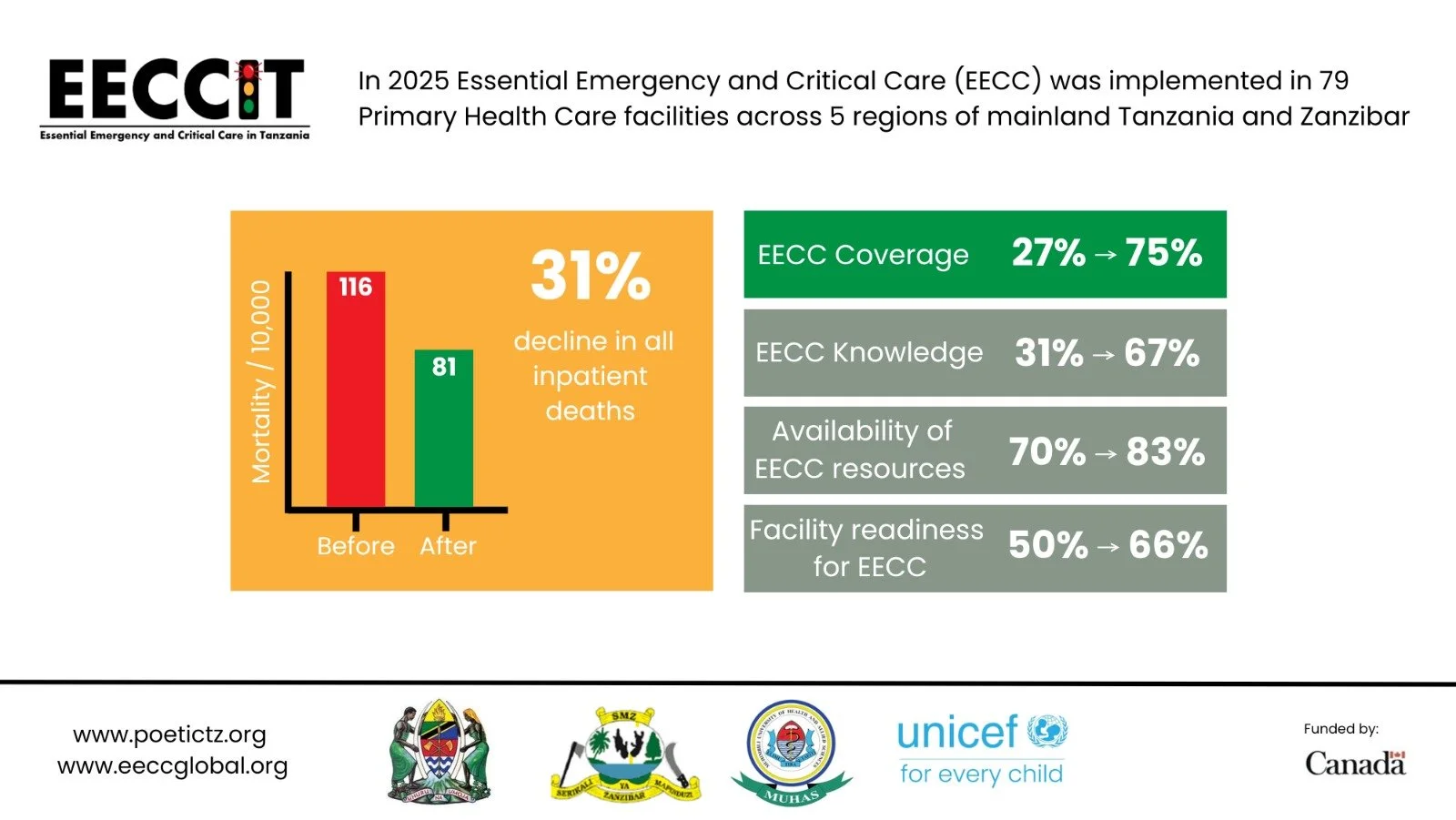
Following implementation, all inpatient mortality was 31% lower than during the same period before the programme began. Coverage of essential care for critically ill patients increased from 27% to 75%, while health worker knowledge and health facility readiness also improved.
These findings add to a growing body of evidence showing that many deaths can be prevented when hospitals consistently provide fundamental aspects of care such as oxygen therapy, intravenous fluids, close monitoring, timely treatment, and effective communication between health workers.
But perhaps the most important lesson is that these improvements were achieved through the health system itself.
EECC was not introduced as a specialist service or a new vertical programme. Instead, it strengthened the care that hospitals already provide to patients of all ages and conditions. This makes the approach both affordable and scalable.
Building on these results, the POETIC Tanzania team at Muhimbili University of Health and Allied Sciences (MUHAS), and EECC Global have developed recommendations for scaling and integrating EECC across Tanzania. The recommendations focus on embedding EECC within national policies, health worker education, health information systems, supervision processes, and routine hospital practice.
The goal is simple: ensure that every critically ill patient receives basic lifesaving care, regardless of where they are treated.
Tanzania's experience offers an important example for other countries. At a time when health systems face growing demands and limited resources, strengthening the delivery of essential care may be one of the most effective ways to save lives.
The evidence suggests that EECC works.
The opportunity now is to ensure that every critically ill patient can benefit from it.
Read the full results from Tanzania and the recommendations for national scale-up.