
First EECC Training Delivered in Tanganyika Province, DRC
Essential Emergency and Critical Care (EECC) has expanded its reach this month with the successful delivery of the first phase of implementation activities in Tanganyika Province, Democratic Republic of the Congo (DRC).
From 14th –19th August, healthcare workers from hospitals across Kalemie took part in a week of training to strengthen their ability to recognise and care for critically ill patients using the simple, evidence-based approaches that underpin EECC.
Participants represented three hospitals in the province:
Kalemie General Referral Hospital
Undugu Hospital, Kisebwe
Shalom Hospital, Kahinda
The programme combined a Hospital Readiness Assessment with two complementary training courses designed to build both immediate clinical skills and long-term local capacity.
An EECC Training of Trainers (ToT), held at Shalom Hospital, equipped future facilitators with the knowledge and teaching skills needed to train colleagues in their own hospitals and beyond. Alongside this, an EECC Provider Training at Undugu Hospital focused on the practical delivery of essential care for critically ill patients through interactive teaching and simulation-based learning.
Throughout the week, participants demonstrated their technical knowledge alongside the non-technical skills that are equally vital to the care of critically ill patients, including communication, teamwork and leadership. Those who showed exceptional commitment and the ability to apply what they had learned in practice will now be considered for membership of the new Tanganyika EECC Hub.
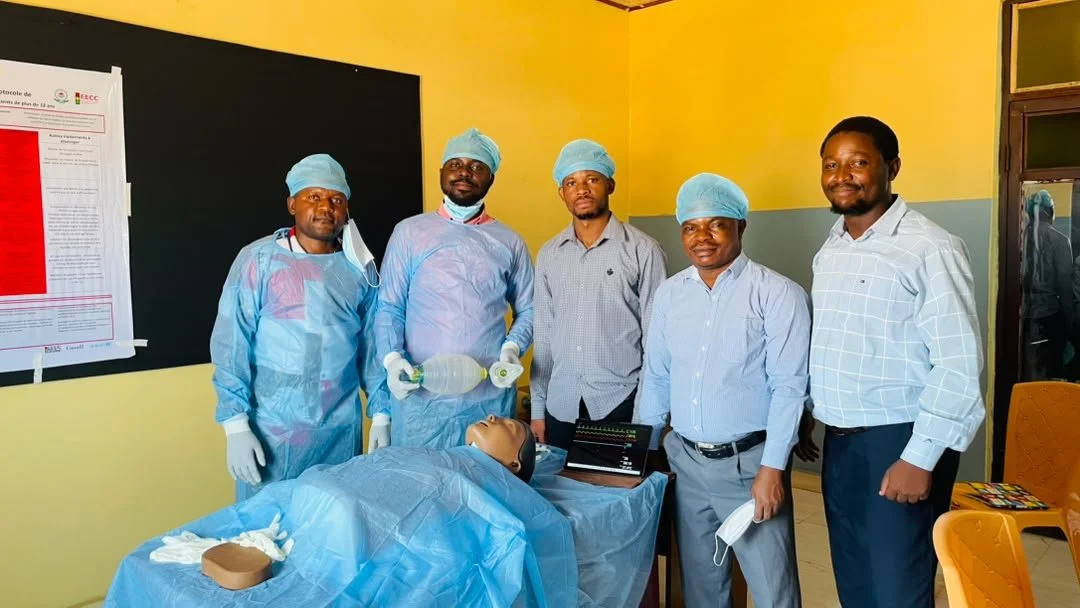
Successful EECC Training participants
The creation of a local EECC Hub will help ensure that training and implementation continue to be led by healthcare professionals within Tanganyika Province. By developing a network of experienced trainers and champions, the Hub will support ongoing education, mentorship and future implementation activities, strengthening EECC across the province and, ultimately, more widely across the DRC.
Training was supported with simulation mannequins and other educational equipment provided by Global SPOOA-PM AFRICA and SMART VISION CONSULTING, enabling participants to practise realistic clinical scenarios in a safe learning environment.
EECC implementation succeeds because it is built on local ownership. By combining practical training, hospital readiness assessments and investment in future trainers, the Tanganyika programme has strengthened local capacity to deliver essential care for critically ill patients, laying the groundwork for continued expansion across the province.
We look forward to following the progress of the EECC Hub in DRC as it continues to expand training, support healthcare workers and help ensure that more patients receive the essential care they need when they need it most.