
When Every Breath Became a Struggle
“I was very worried when our brother struggled to breathe… when we reached the hospital, the nurses acted so quickly.”
When 64-year-old Christopher began gasping for air at his home in rural Tanzania, his family watched with growing fear. His breathing became faster, his chest tightened, and by the time they reached Vwawa District Hospital, he could barely speak.
Nurses trained in Essential Emergency and Critical Care (EECC) received him at the outpatient department. A rapid assessment showed he was breathing rapidly and his oxygen level had dropped to a dangerous level, even though he was still fully conscious and his blood pressure was stable. The nurse started oxygen immediately using nasal prongs connected to the oxygen concentrator available in the department, then helped him into a semi-sitting position to ease his breathing.
Minutes later, his oxygen level had risen out of the critical range. A doctor ordered investigations, which confirmed heart failure, a condition that can cause fluid to accumulate in the lungs, making each breath harder than the last. Christopher was admitted to the medical ward, where treatment for heart failure began alongside continued oxygen therapy.
“In our ward, we reassessed him and saw he needed to stay on oxygen,” recalls the Nurse. “Positioning him upright helped him breathe more comfortably. Thanks to EECC training, we were able to act quickly, and seeing him recover is incredibly rewarding.”
Over the next three days, Christopher’s breathing steadied and his oxygen levels normalised. He no longer needed oxygen support, and by the following day he was strong enough to go home.
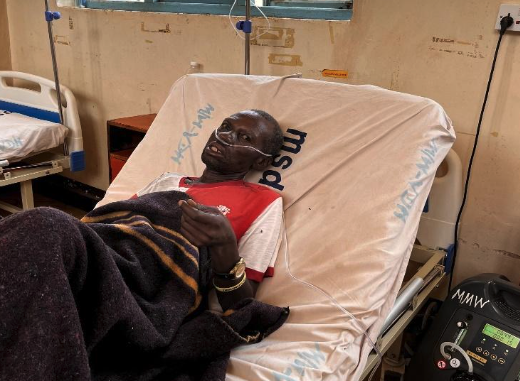
Christopher with normalised oxygen levels
For patients with heart failure, delayed treatment can mean rapid decline and even death. Christopher survived because the danger was recognised early, oxygen was available, and trained staff took immediate action.
As EECC becomes part of routine care across Tanzania, more patients like Christopher will receive timely support, giving families hope even in the most frightening moments.