
Anaesthesiologists and EECC: Strengthening the frontline of care for critically ill patients
A new article by Karima Khalid and colleagues highlights an important but sometimes under-recognised truth: anaesthesiologists are central to improving care for critically ill patients, not only in operating theatres and intensive care units, but across entire health systems.
The paper explores how Essential Emergency and Critical Care (EECC) provides a practical framework that helps anaesthesiologists extend their impact beyond specialist settings to improve the identification, stabilisation, and treatment of critically ill patients wherever they are treated.
Critical illness is everyone’s business
Health emergencies such as pandemics and mass casualty events have shown how easily critically ill patients can be missed when systems are not designed to recognise and respond to deterioration early. Even in normal times, many patients deteriorate on general wards without receiving timely life-saving care.
Recent research from Africa illustrates the scale of this challenge: more than half of critically ill hospital patients were not receiving even basic care, and around one in five died within seven days.
EECC was developed to address exactly this problem. By focusing on the most essential, low-cost clinical processes, such as airway management, oxygen therapy, IV fluids, and vital signs monitoring, EECC helps ensure that all critically ill patients receive the basic care they need, regardless of where they are treated.
A systems approach to saving lives
A key message of the paper is that EECC is not just a clinical checklist. It is a systems approach that strengthens readiness, teamwork, and communication.
EECC defines both the clinical processes needed to identify and treat critical illness and the hospital readiness requirements needed to deliver this care. These include basic equipment such as pulse oximeters and oxygen supplies, trained staff available at all times, clear routines for escalation, and guidelines to support consistent care.
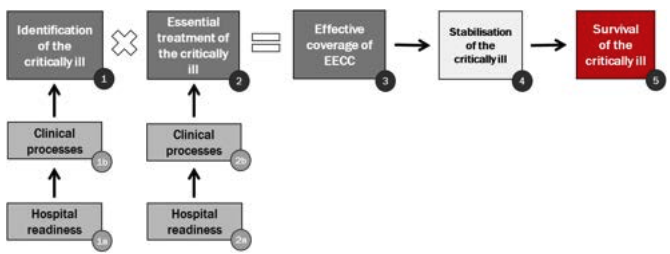
EECC Conceptual Framework
This reflects a core EECC principle familiar to the EECC Global community: improving outcomes often depends on strengthening simple systems rather than relying solely on advanced technologies.
Preparedness, response, and recovery
The authors also describe how EECC supports anaesthesiologists across the three phases of health emergencies: preparedness, response, and recovery.
In preparedness, EECC helps ensure hospitals have the essential resources, training, and routines needed to respond to critical illness. During emergencies, EECC guides rapid identification and stabilisation so that simple interventions are delivered quickly. After emergencies, EECC supports learning and quality improvement to strengthen future responses.
This approach reinforces the idea that EECC is not just for crises. The same practices that improve everyday care also help health systems respond more effectively when emergencies occur.
Leadership beyond the operating theatre
Perhaps the most important message is about leadership. The paper highlights how anaesthesiologists can act not only as clinicians but also as system leaders: supporting training, improving hospital readiness, and strengthening multidisciplinary teamwork.
By championing EECC, anaesthesiologists can help ensure that essential life-saving care is consistently available, coordinated, and delivered in time.
A shared responsibility
While the paper focuses on anaesthesiologists, its message applies to all healthcare providers. EECC is designed to be delivered by teams: doctors, nurses, and other health workers; working together to ensure no critically ill patient is overlooked.
As EECC continues to grow globally, this kind of leadership and collaboration will be essential to achieving its ultimate goal: making sure every critically ill patient receives the essential care they need to survive.