
From Dar to Addis: Building a Global Network of EECC Trainers
In March, two Training of Trainers (ToT) courses, one in Dar es Salaam and one in Addis Ababa, highlighted something important about EECC today: this is no longer a single-country effort. It is becoming a connected, international movement.
Just two weeks after the global ToT in Tanzania brought together participants from across Africa and beyond, a second ToT took place at Yekatit-12 Hospital Medical College in Addis Ababa. This time, the focus was on building national and regional training capacity in Ethiopia, while continuing to draw on international collaboration.
A practical, hands-on training
The Addis ToT followed the same core model: learning by doing.
Fifteen healthcare professionals (doctors and nurses working in emergency units, ICUs, and wards) spent the day not just reviewing EECC concepts, but practising how to teach them.
Participants worked in small groups to:
Deliver short teaching sessions
Practice peer-to-peer skills teaching
Facilitate guided simulations
Give and receive structured feedback
For many, simulation-based teaching was new. Initial hesitation was expected, but quickly gave way to confidence as participants practised facilitating scenarios and debriefing colleagues.
This progression, from unfamiliarity to competence, is exactly what the ToT is designed to achieve.
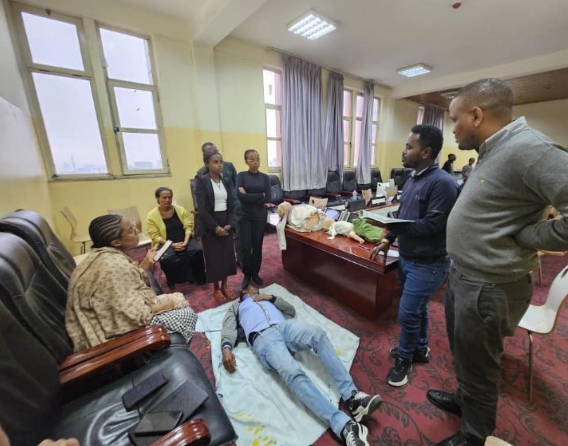
Participants practice guided simulations
Strong engagement, clear outcomes
The workshop achieved its core objective: building a cohort of trainers ready to deliver EECC training locally.
Participants demonstrated the ability to structure teaching sessions, run skills stations, and lead simulations: key components of the EECC course.
Feedback was consistently strong. Evaluation scores averaged 4.8 out of 5 for preparedness to independently run the course, with participants describing the training as “excellent,” “very professional,” and “outstanding.”
There was also clear demand for more: longer courses, more simulation time, and ongoing mentorship. This reflects both the ambition of participants and the practical reality of embedding new teaching approaches.
Institutional commitment and next steps
A critical feature of the Addis ToT was institutional engagement. The Provost of Yekatit-12 Hospital Medical College closed the workshop with a commitment to integrate EECC into both clinical care and training programmes, an important step toward sustainability.
Participants also expressed strong interest in joining the EECC Network, signalling a desire to remain connected beyond the training itself.
A growing international model
Taken together, the ToTs in Dar es Salaam and Addis Ababa tell a broader story.
In Dar, participants came from ten countries. In Addis, international trainers worked alongside local faculty to build national capacity. Across both, the same model was applied: train clinicians to teach, support them to deliver, and connect them into a wider network.
This is how EECC scales.
Not through isolated trainings, but through a distributed model, where trainers are developed in multiple countries, supported by shared methods, and linked through ongoing collaboration.
The result is a growing, international community of clinicians who are not only delivering EECC, but teaching it, ensuring that essential care reaches more patients, in more places, more consistently.