
From Marrakech to Ministries: EECC Gains Ground at WCA 2026
In April, the global anaesthesia and critical care community gathered in World Congress of Anaesthesiologists 2026, hosted by the World Federation of Societies of Anaesthesiologists in Marrakech. With thousands of clinicians, researchers, and policymakers from more than 130 countries, the congress provided a clear lens on the future of perioperative and critical care. For EECC Global, it was also a moment to take stock of how far the field has come, and where it must go next.
Bringing EECC into the global conversation
Throughout the week, EECC Global’s presence was both visible and purposeful. At a dedicated booth, conversations with national anaesthesia societies focused on a simple but consequential idea: that every patient, everywhere, has the right to receive Essential Emergency and Critical Care.
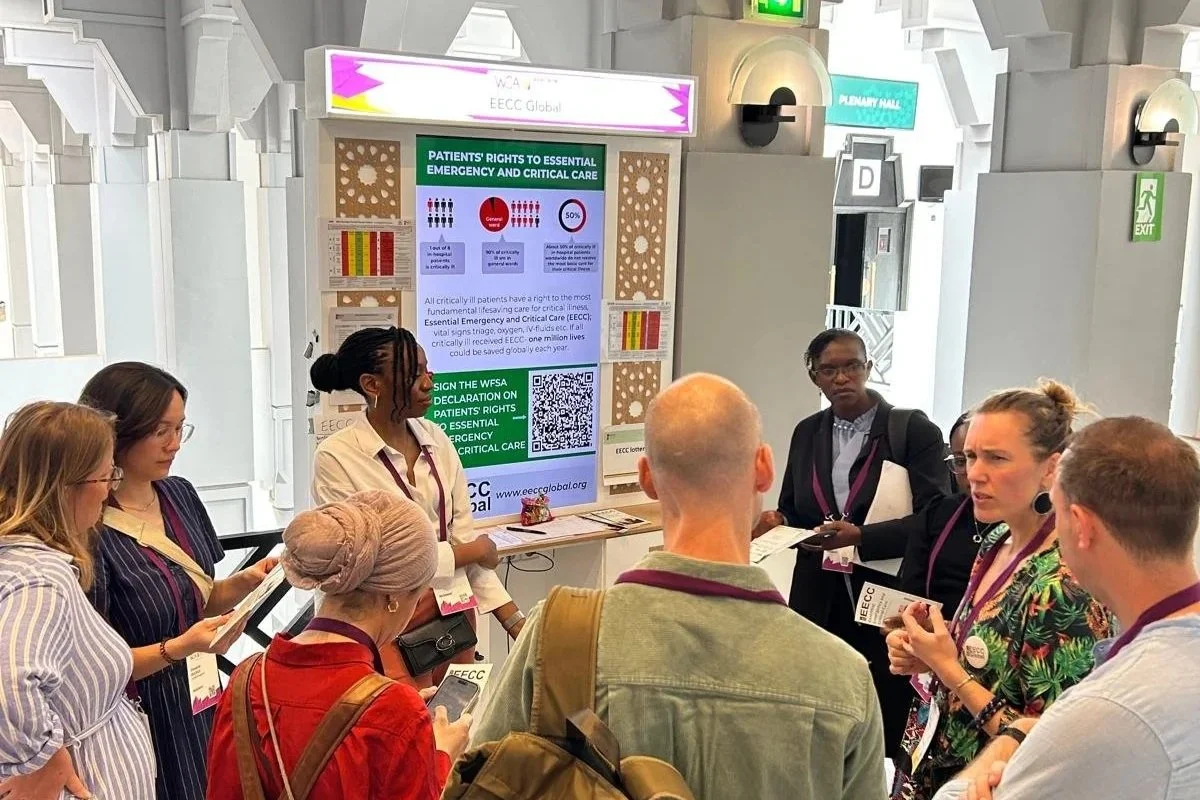
The EECC Global booth
This was not abstract advocacy. It was grounded in evidence and implementation. Presentations led by Karima Khalid explored critical illness outcomes, the realities of delivering care in constrained settings, and the ethics of global collaboration. Alongside this, EECC Champions from multiple countries shared practical insights from hospitals where EECC is already being implemented, demonstrating that strengthening basic care processes can translate into measurable survival gains.
A recurring theme was that critical illness is not confined to ICUs. Whether in operating theatres, recovery rooms, or general wards, the ability to recognise and respond early remains inconsistent. EECC offers a way to close that gap, not through complexity, but through reliability: vital signs monitoring, oxygen, fluids, airway support, and clear protocols that ensure action.
From discussion to endorsement
One of the most tangible outcomes of the congress was the growing support for the Declaration on Patients’ Rights to Essential Emergency and Critical Care. Many national societies formally endorsed the declaration during the event, adding momentum to what is becoming a significant shift in how essential care is understood and prioritised.
To date, more than 20 national and international organisations have signed, including the American, Indian and South African Societies of Anesthesiologists, and the Ethiopian Society of Anesthesiology, Critical Care, and Pain Medicine Physicians. This breadth matters. It signals alignment across high-, middle-, and low-income settings that EECC is not optional: it is foundational.
Endorsement at society level is more than symbolic. These organisations play a central role in shaping national clinical standards, training curricula, and policy dialogue. As support grows, so too does the likelihood that ministries of health will adopt EECC as a core component of health system strengthening.
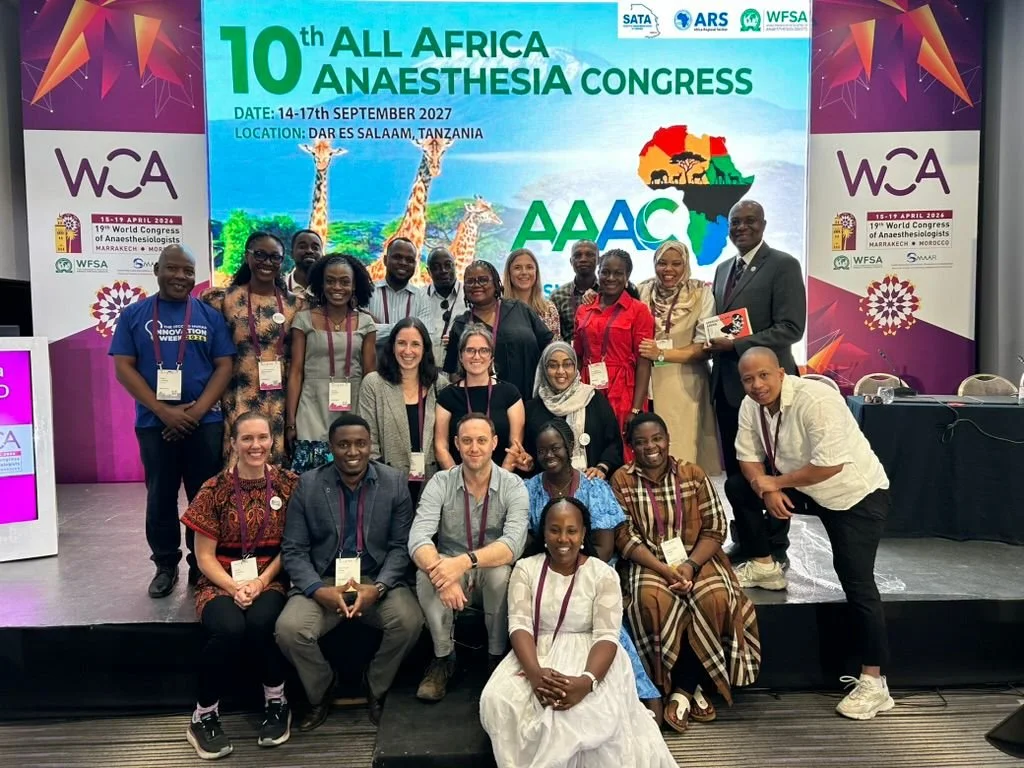
EECC Champions and supporters at WCA 2027
A direction of travel
The conversations in Marrakech were not about introducing a new concept. They reflected a field increasingly converging on a shared understanding: that improving outcomes for critically ill patients depends on getting the basics right, consistently, across all hospital settings.
For EECC Global, WCA 2026 marked a step forward in that convergence. From evidence to advocacy, and from individual champions to institutional endorsement, the trajectory is becoming clearer.
The task now is to translate that momentum into implementation at scale, so that the right to essential emergency and critical care is not only recognised, but realised in practice.