
“I Was Very Scared, But the Nurse Acted Immediately” – How EECC Saved Newborn Rodricky
“When I saw my baby struggling to breathe, I was very scared. But the nurse immediately gave him oxygen and called the doctor. Thanks to their quick response, my baby improved day by day”
For new mother Rehema, the safe delivery of her baby boy, Rodricky, by cesarean section in a district hospital in Tanzania’s highlands was a moment of joy and relief. But just hours later, joy gave way to fear. Rodricky began gasping for breath, and his skin turned bluish—a sign of dangerously low oxygen in his blood.
At that critical moment, a nurse trained in Essential Emergency and Critical Care (EECC) was present on the ward. She quickly assessed Rodricky’s vital signs and found severely low oxygen levels, rapid breathing, and a fast heartbeat. She acted without hesitation: oxygen tubing was gently placed in his nose, an intravenous line was started, and the doctor who had delivered him was alerted.
Within minutes, Rodricky’s oxygen levels rose from a life-threatening 45% to 92%. The blue colour faded from his tiny body, though his breathing remained laboured. Soon after, the doctor confirmed he was suffering from respiratory distress syndrome, a dangerous condition in newborns. He was transferred to the hospital’s neonatology unit for specialist care.
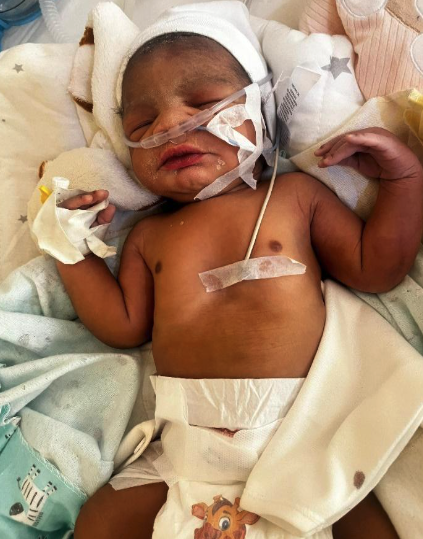
Rodricky receiving oxygen - and recovering
For the next seven days, Rodricky received oxygen, nutrition through a feeding tube, and continuous monitoring. Gradually, his strength returned. By the end of the week, he no longer needed oxygen and was able to breastfeed normally. The following day, he was discharged—healthy, stable, and in his mother’s arms.
"When I saw Rodricky turning bluish, I knew he was in danger,” recalls the nurse. “Thanks to my EECC training and the availability of oxygen equipment, we could act immediately. Watching him improve and go home safely was so rewarding.”
Stories like Rodricky’s show the vital role EECC plays in rural hospitals. Low oxygen in newborns can kill within minutes, but with trained staff and basic equipment—like pulse oximeters and oxygen concentrators—lives can be saved. This readiness is not by chance: it is part of the EECC in Tanzania (EECCiT) programme, supported by UNICEF Tanzania and made possible through funding from Global Affairs Canada through the CanGive initiative. Their support ensures that even the smallest, most vulnerable patients receive timely, life-saving care.
Rodricky’s story is one of survival, but it also points to a future where many more mothers will go home with healthy babies, thanks to EECC. With continued investment, more hospitals can be equipped and more staff trained—so no newborn’s first days of life are cut short by a lack of essential care.
This is EECC: rapid recognition, simple interventions, and the power to save lives.